Wednesday, October 14, 2009

Kancamagus Highway - birthday gift


8 x 10 in. (20 x 25 cm) oil on canvas panel.

Once, a while back, Kittie and I drove the Kancamagus Highway in New Hampshire, about 26 miles of spectacular views of the White Mountains. Since we were there at leaf-peeping time, I mostly got to see the rear bumper of the RV ahead of us. This is one of the rare views, which I painted for Kittie for her birthday, so, not available for sale.

Sunday, October 11, 2009

A stop in Whitefish and the addition of a private car


Our Amtrak Empire Builder passenger train stopped just at deep sunset in Whitefish, Montana. It's a tiny town, but well known in the northwest (at least in the past) for its posh resorts and ski lodges.

It was one of the longer stops along the Empire Builder route, allowing train personnel to top up fuel and replenish food and goodies. Passengers can debark and stretch their legs. I didn't really need it - we had boarded at East Glacier (National Park) less than forty minutes earlier. But I didn't want to miss the chance to see us on the outside. Again. I hopped off the train at all of our longer stops.

So I wandered out onto the platform of the late Victorian (and beautifully maintained) train station. I didn't see it come up, but an old. wooden passenger car was being shuttled off a siding and staged behind our train by a switch engine. The car was ornate, old, gleaming in the lamplight. A party was in full swing, visible through the large glass windows. The music could be heard, rock-and-roll.

An Amtrak worker on the platform of the old car stood waiting for coupling of the car, so I asked him what this was.

"Private car," he said. It turns out that Amtrak will attach private cars to its scheduled runs, for a hefty fee.

"Look incredible," I said.

"It should," he said. "It was the private car of [here he inserted the name of a fabulous party-animal industrial tycoon of the late 1800s]. Crystal chandeliers, mahogany interior, even has a complete master bedroom suite with private bath and shower."

I didn't write down the name of the tycoon on my trip notes - I've been racking my brains and it may come back to me... but it may, and in fact probably, will not.

I took the photo which is the basis for my oil above, then watched as a switcher gently connected the old car. The 21st century rock-and-roll audible outside it was a strange, anachronistic touch.

As it turns out, the photo was not of the scene above. The Empire Builder swept straight off to the left. But the picture was so dark that a printout made the dark shapes of one-story shops along a street masquerade as our train. It looked as though our cars curved around to the right, pointing into the wall of mountains north of town. Only after I painted the little canvas did I revisit the photo and discover my mistake. Mistakes can make far more interesting pictures than reality...

Monday, October 5, 2009

A Flurry of Still Lifes and a Floral or Two

A smattering of small paintings and (for me) a big one... at 8 x 10....

Beach Rose + Mini Landscape
6 x 4 in. (15 x 10 cm) original oil on hand-made canvas panel. Unframed. Available in my Etsy store
Wild beach roses are fascinating. They're all over the east coast, along beaches and dunes, bringing color and fragrance to the seaside.

The Web doesn't reveal their origin - or more precisely, my search skills didn't turn it up. The rose burst forth first in the Orient, Wikipedia assures me. It made it to England well in time for the War of the Roses, probably because finicky roses allowed a landed aristocrat to crow, "My gardener is better than your gardener."

But the beach rose is a blue-collar rose. It doesn't require coddling or attention. It grows anywhere, even (as here) in sand, beaten by salt wind and scoured by winter storm.

Did ours escape from colonial gardens? Did rose hips find their way into cargos from the Orient, back when Massachusetts blue-blood money was piling up, thanks to the 18-19th Century tea, porcelain and opium trades?

The little landcape here is of the beach-rose-lined walk that heads past Clarke Pond to Gray Beach, part of the Coolidge Reservation in Magnolia (okay, Manchester) Massachusetts. Only the outline of the foundation is left of the once-fabulous Coolidge mansion overlooking Massachusetts Bay - Boston is visible, and so is Cape Cod on a clear day.

Off Gray Beach is Kettle Island. Artistic license allows me to bring it a lot closer to make a sort of interesting background.

It's a great place to gaze at the Bay, and at the fabulous coastal homes in the area. And to ponder why the marble Georgian-style mansion existed for less than 50 years, built and later razed by the modestly-named Thomas Jefferson Coolidge. No, I dont know if he was related to President Calvin. Silent Cal, he was called. T.J. is silent as well, having passed away in the 1960s.

Bedding Dahlia Study
4 x 6 in. (10 x 15 cm) original oil on hand-made canvas panel. Available in my Etsy store

I'm planning to capture summer on canvas, as Fall grows on us in the Northeast. This is a quick study of a couple of our bedding dahlias, caught on a sunny day. Even at 6 x 4, they are painted larger than life size here... bedding dahlias are a grand, enthusiastic if tiny celebration of form and color.

Still Life with Gardenia
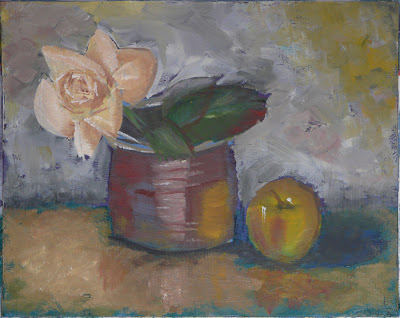
8 x 1o in. (20 x 26 cm) Painterly still life on commercial canvas panel. Available in my Etsy store

I'll be building my skills for years to come, if the time is allowed me. I'm happy with this one, which is sort of impressionistic, and it's a lot larger than most of my oeuvre.

The vase is a jar from my days as a professional potter in the 1970s. Its form is a cross between 19th C. American stoneware canning jars and Egyptian alabaster forms, both strong, expressive geometries.

By the way, in my future still lives, you'll see this jar in varying proportions - here, I've made it low, chubby jar. In real life, it's stocky, but a lot taller.

The glaze is the rich shiny red-brown of Albany slip, no longer mined; raw iron oxide dabbed on the pot under the slip blooms into a beautiful deep iron red in spots. The apple is a Gala, and its red bloom plays endlessly with bright yellow areas.

In the painting's background, I've played a little with complementary colors. If anyone cares, it's a tip of the hat to the improbably named Merlin Enabnit, who authored two very quirky books on color for Walter T. Foster.

(I like to tell people that I've studied extensively under Walter T. Foster. He produced hundreds of $1 how-to-paint books from the 1940s through the 70s - and his publishing house is continuing to offer low-cost painting manuals. Some of Walter's original line is quite good; some of them are just shovel jobs, many just galleries of examples of Walter's personal art collection or borrowings from earlier publications, without much redeeming pedagogic content.)

Still Life - Ginger Jar, Apples and Dahlia
6 x 4 in. (15 x 10 cm) original oil on hand-made canvas panel. Sold.

A little still life with another of my pots from my stint as a potter, 1969-1981 or so. The pot is this a white (actually oatmeal) glazed vase in the classic shape of a small Chinese ginger jar. On it is a leaf pattern in a soft cobalt blue, a mix of cobalt oxide, manganese carbonate and black iron oxide - and based on the natural cobalt ores of China, wih all the "impurities" that make it so much richer than the brash, blaring blue of pure cobalt oxide.

Michael Cardew, a great man and a British crafts potter from early-mid 20th C. described the role of the hands in wheel-thrown pottery. The right hand is controlling. Without it, the volume of the pot would disappear; the wall would simply slump. But the left hand, the one inside the pot, is the one that will confer life to the shape. A final, often whisper-gentle pass with the left hand alone will belly out the shape. This ginger jar benefited from Cardew's touch, with its gently outcurved sides.

Lying on the mahogany is an orange dahlia, which is about to find a home in the jar.

I took a shot at a Dutch-ish dark background. You likely wouldn't have a wall this color. But it's a nice gray.


Still Life - Apples and Stoneware Bowl

6 x 4 in. (15 x 10 cm) original oil on hand-made canvas panel. Available in my Etsy store

A Gala and a Honeycrisp apple cluster around a little stoneware bowl with only "USA 5 in." molded into the bottom. The rim is clear of the gorgeous blue glase, so these would have been stacked rim-to-rim, then foot-to-foot, then rim-to-rim and so on, many feet high in the giant high-fire kilns of (probably) an Ohio stoneware factory anywhere between 1920 and 1950.

The relatively tiny diameter would make it ideal for tucking in and around bigger pieces. They served to increase the density of wares in the kiln. You don't want open areas in a high-fire kiln, because there's a huge fuel economy gained when at white heat, the pots radiate heat to each other. They have to be fairly close together for that to happen.

I kind of like the polished mahagony table in this setting, a rich offsetting color for the apples who are basking (complementarily speaking) in the blue of the bowl.

Still Life - Mum in Glass Vase

6 x 4 in. (15 x 10 cm) original oil on hand-made canvas panel. Available in my Etsy store


I've just discovered Eduoard Manet, who is not - to the bane of all beginning art history students - Claude Monet (but without Manet, no Monet). Manet, with an "a", did incredible still lifes toward the end of his too-short life.

Ed copied Old Masters when he was starting out. Now he's the old master, and I'm trying to copy him. My effort is a little crude, but charming. To me, at least.

Under the vase, a white silk handkerchief with an openwork pattern, part of a collection from my wife's aunt. Aunt Tish never went a day dressed in anything other than crisp, classic and gorgeous high-fashion clothes, pointed up with carefully selected accessories. This is one of the latter.

Two Mini-panoramas from last summer's anniversary trip

Another hiatus - and another update.

I make my own canvas panels from watercolor paper, acid-free glue and extra-fine 100% canvas in a miniature weave, AKA white bedsheet. Left over from each watercolor sheet is a strip 1 x 12 inches, and I've begun to turn these into 1 x 6 in. mini-panoramas.

The first - sunrise over the Columbia river.

1 x 6 in. mini panorama, oil on canvas board. Available in my Etsy Shop

I wake early, even on vacation, so I left our Amtrak Empire Building bedroom and made my way up to the observation car. I sat down next to a teenager. The sun was just giving a little color to the summer sky.

"You're up early," I said. Yep, he said. "And you're going where?" I and my sister are riding to Pasco. "Washington?" Yep.

He and his sister had taken the eastbound Empire Builder the week before, hopping off at Cut Bank, Montana, where their mother met them and drove them back to Helena, where she lived with her new husband. I miss her, he said. After a pause, he said, There's nothing to do in Helena. I was bored out of my mind.

"How old are you?" Fourteen. "Ah," I said. "At fourteen, boring is easy. At my age, nothing is boring. There is nothing you get to know enough about. There's always something new to dig into."

She makes the best peanut butter sandwiches, he said. I thought to myself that there is nothing to a peanut butter sandwich - what can you possibly mean? A year later it came to me: his mother made it. It was something in his life that he would now have only once in a while, and only after many hours by train and car.

The sun was now up and the train, having skittered catty-corner down from Spokane to Pasco, slowed to a stop. My new friend got up, woke up her sister who was sleeping across three observation car seats, and they left, saying goodbye.

The train pulled out again, following the Columbia river, wheeling directly east when the river did. The sunrise was magnificent.

Sunrise in Crofton

1 x 6 in. mini panorama. Available in my Etsy Shop

Later in our trip, having rented a car in Portland and visiting old friends who had moved from the Boston area, we stayed on Vancouver Island at a bed-and-breakfast in Crofton, British Columbia. The little town overlooked Saltspring Island, where, it turned out, there was a quirky but excellent little seafood restaurant. An hourly ferry took us less than a mile across Vesuvius Bay and we lucked into a seat. It was August 17th, our 45th anniversary, and the meal apparently was meant to be: we walked in just as someone on the phone group was canceling their reservation.

Our seat on the outdoor balcony overlooked the bay and the weather was perfect. At the table next to us (one table closer to the bay) was a couple celebrating their first anniversary. Next to us was a couple celebrating their one week anniversary. We all enjoyed the coincidences, even the people dining on down the balcony. A perfect evening.

The mini panorama is on the Crofton side, and the little bridge is part of the tiny town's Shore Walk.

Thursday, August 20, 2009

Some new ones - mostly florals

Some new ones...


Experiment with a genre used now and again by Gary Jenkins - floral with landscape vignette. In this case, the vignette is another scene of North Dakota sunflower fields taken from the train window on our 45th anniversary trip. 6" x 4" (sold)


The flooded quarry at Halibut Point State Park, Rockport, Massachusetts. The single red tree growing precariously in cracks in the quarry wall caught my attention. 6" x 4". Available in my Etsy Shop


An incredible gladiolus from our garden, a random survivor from last year... and from a random assortment. 4" x 6". Available; contact me for for more information.


Another random survival gladiolus, doubly incredible. I spent nearly two hours mixing purples until I achieved 0ne close to the original. 4" x 6" Available; contact me for more inforatmoin


Our glads and a hydrangea on a fence line graciously installed by our neighbors. 6" x 4" (Not available)


Sunday, August 16, 2009

Long hiatus and a new direction

Busy as could be, for months... I've taken a new direction, dabbling in oils, and will be posting new paintings here. Meanwhile, here are a few:


Perfect beach day, northern Michigan (6" x 4") Available in my Etsy Shop


Two rose of sharon (6" x 4"). Available in my Etsy Shop


Sunflower fields in morning mist - taken from the window of our train last summer on a memorable 45th wedding anniversary trip... by train from Chicago to Glacier National Park via Amtrak's Empire Builder, then on to Portland and finally up to Vancouver Island B.C.
(6" x 4"). (Not available... Kittie wanted this... she loved the colors of the sunflower fields.)


Red daylily and bud, abstract background (sold). (6" x 4")

At the moment, I put selected ones on eBay for a little more than the cost of materials. (Trying to keep the hobby self-supporting).

Wednesday, February 11, 2009

Small free collection of Art Deco Papers: Birthday gift from me to you


Download the 5.4 MB paper pack here.

Contents:
Papers, all 12 x 12 at 200 dpi. They'll print just fine a 300 dpi.

They are variations on two basic designs

Based on a colophon,a stylized daylily in a circle, resting on a stylized stem with a flower bud on each end
  • Slate blue with creamy orange motif
  • Navy blue with blue and orange motif
  • Black with blue and orange motif
  • Black with white motif
  • Gray with slate blue and orange motif
  • Gray with navy blue and dark orange motif
  • Gray with light slate blue and orange motif
Based on a circle motif on the title page for "The Firefly Who Scattered Sparks":
  • Cream with orange and blue motif
  • Slate blue with yellow and orange motif
  • Purple with dark blue and dark orange motif
From the last freebie fast forward 30 years
We're fast-forwarding 25 years from our last freebie, moving in time from the Arts & Crafts movement in 1900 to Art Deco in 1925, with it love of geometry and color.

This paper pack uses artwork in a children's book published by The Volland Company in the 1925. The illustrations are by VE Elizabeth Cadie.

I wish I knew more about Ms. Cadie. There is almost nothing on the Web about her except exclamations over her lively Deco illustrations. It's unclear whether her name was Ve or whether this is a V. E. Elizabeth Cadie. The two motifs in these papers come from details. One is a colophon, the other a title page in The Cat Whose Whiskers Slipped by Ruth Campbell... and I cannot find anything about Mrs. Campbell.

Her stories are delightful.

Volland is well-represented on the net, primarily because it was the Joliet, Illinois (Chicago) publishing house for Jonny Gruelle and his Raggedy Ann and Andy series.
Art Deco
Ah - it's too complex. See the Wikipedia entry for Art Deco and the article about its birth place and time, the 1925 Exposition Internationale des Art Decoratifs et Industriels Modernes. The style partakes of all sorts of attributes: Art Nouveau, Cubism, Modernism, and plenty more.

Downloading and installing the SMB format
You can download it (5.4 MB) here. The file is an .SMB for Scrapbook Max and SBM automatically installs it.

To use the file, when your Web browser asks you what you want to do with the file, click the "Open" button (Internet Explorer or Opera browsers) or choose "Open with: Scrapbook MAX!" and click OK (Firefox browser). Once the file has downloaded, you should see a message that tells you that the template has been successfully installed. It will now be available the next time that you create a new project or page.
Don't have Scrapbook Max?
For those of you without Scrapbook Max: the file is really a ZIP file. You download it, change the file extension to .ZIP and use any ZIP utility to retrieve each of the JPEGs and PNGs. But you should get Scrapbook Max...
Styles
Foster + McKeehan types

clean lines
graphic
eclectic
hip & trendy
classic