A smattering of small paintings and (for me) a big one... at 8 x 10....
Beach Rose + Mini Landscape

6 x 4 in. (15 x 10 cm) original oil on hand-made canvas panel. Unframed. Available in
my Etsy store
Wild beach roses are fascinating. They're all over the east coast, along beaches and dunes, bringing color and fragrance to the seaside.
The Web doesn't reveal their origin - or more precisely, my search skills didn't turn it up. The rose burst forth first in the Orient, Wikipedia assures me. It made it to England well in time for the War of the Roses, probably because finicky roses allowed a landed aristocrat to crow, "My gardener is better than your gardener."
But the beach rose is a blue-collar rose. It doesn't require coddling or attention. It grows anywhere, even (as here) in sand, beaten by salt wind and scoured by winter storm.
Did ours escape from colonial gardens? Did rose hips find their way into cargos from the Orient, back when Massachusetts blue-blood money was piling up, thanks to the 18-19th Century tea, porcelain and opium trades?
The little landcape here is of the beach-rose-lined walk that heads past Clarke Pond to Gray Beach, part of the Coolidge Reservation in Magnolia (okay, Manchester) Massachusetts. Only the outline of the foundation is left of the once-fabulous Coolidge mansion overlooking Massachusetts Bay - Boston is visible, and so is Cape Cod on a clear day.
Off Gray Beach is Kettle Island. Artistic license allows me to bring it a lot closer to make a sort of interesting background.
It's a great place to gaze at the Bay, and at the fabulous coastal homes in the area. And to ponder why the marble Georgian-style mansion existed for less than 50 years, built and later razed by the modestly-named Thomas Jefferson Coolidge. No, I dont know if he was related to President Calvin. Silent Cal, he was called. T.J. is silent as well, having passed away in the 1960s.
Bedding Dahlia Study

4 x 6 in. (10 x 15 cm) original oil on hand-made canvas panel. Available in
my Etsy store
I'm planning to capture summer on canvas, as Fall grows on us in the Northeast. This is a quick study of a couple of our bedding dahlias, caught on a sunny day. Even at 6 x 4, they are painted larger than life size here... bedding dahlias are a grand, enthusiastic if tiny celebration of form and color.
Still Life with Gardenia
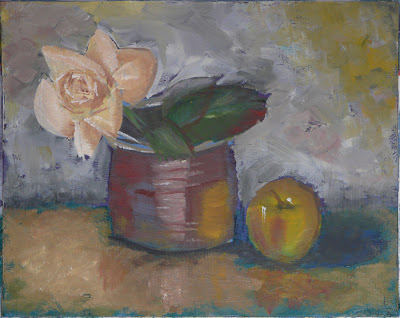
8 x 1o in. (20 x 26 cm) Painterly still life on commercial canvas panel. Available in
my Etsy store
I'll be building my skills for years to come, if the time is allowed me. I'm happy with this one, which is sort of impressionistic, and it's a lot larger than most of my oeuvre.
The vase is a jar from my days as a professional potter in the 1970s. Its form is a cross between 19th C. American stoneware canning jars and Egyptian alabaster forms, both strong, expressive geometries.
By the way, in my future still lives, you'll see this jar in varying proportions - here, I've made it low, chubby jar. In real life, it's stocky, but a lot taller.
The glaze is the rich shiny red-brown of Albany slip, no longer mined; raw iron oxide dabbed on the pot under the slip blooms into a beautiful deep iron red in spots. The apple is a Gala, and its red bloom plays endlessly with bright yellow areas.
In the painting's background, I've played a little with complementary colors. If anyone cares, it's a tip of the hat to the improbably named Merlin Enabnit, who authored two very quirky books on color for Walter T. Foster.
(I like to tell people that I've studied extensively under Walter T. Foster. He produced hundreds of $1 how-to-paint books from the 1940s through the 70s - and his publishing house is continuing to offer low-cost painting manuals. Some of Walter's original line is quite good; some of them are just shovel jobs, many just galleries of examples of Walter's personal art collection or borrowings from earlier publications, without much redeeming pedagogic content.)
Still Life - Ginger Jar, Apples and Dahlia

6 x 4 in. (15 x 10 cm) original oil on hand-made canvas panel. Sold.
A little still life with another of my pots from my stint as a potter, 1969-1981 or so. The pot is this a white (actually oatmeal) glazed vase in the classic shape of a small Chinese ginger jar. On it is a leaf pattern in a soft cobalt blue, a mix of cobalt oxide, manganese carbonate and black iron oxide - and based on the natural cobalt ores of China, wih all the "impurities" that make it so much richer than the brash, blaring blue of pure cobalt oxide.
Michael Cardew, a great man and a British crafts potter from early-mid 20th C. described the role of the hands in wheel-thrown pottery. The right hand is controlling. Without it, the volume of the pot would disappear; the wall would simply slump. But the left hand, the one inside the pot, is the one that will confer life to the shape. A final, often whisper-gentle pass with the left hand alone will belly out the shape. This ginger jar benefited from Cardew's touch, with its gently outcurved sides.
Lying on the mahogany is an orange dahlia, which is about to find a home in the jar.
I took a shot at a Dutch-ish dark background. You likely wouldn't have a wall this color. But it's a nice gray.
Still Life - Apples and Stoneware Bowl

6 x 4 in. (15 x 10 cm) original oil on hand-made canvas panel. Available in
my Etsy store
A Gala and a Honeycrisp apple cluster around a little stoneware bowl with only "USA 5 in." molded into the bottom. The rim is clear of the gorgeous blue glase, so these would have been stacked rim-to-rim, then foot-to-foot, then rim-to-rim and so on, many feet high in the giant high-fire kilns of (probably) an Ohio stoneware factory anywhere between 1920 and 1950.
The relatively tiny diameter would make it ideal for tucking in and around bigger pieces. They served to increase the density of wares in the kiln. You don't want open areas in a high-fire kiln, because there's a huge fuel economy gained when at white heat, the pots radiate heat to each other. They have to be fairly close together for that to happen.
I kind of like the polished mahagony table in this setting, a rich offsetting color for the apples who are basking (complementarily speaking) in the blue of the bowl.
Still Life - Mum in Glass Vase

6 x 4 in. (15 x 10 cm) original oil on hand-made canvas panel. Available in
my Etsy store
I've just discovered Eduoard Manet, who is not - to the bane of all beginning art history students - Claude Monet (but without Manet, no Monet). Manet, with an "a", did incredible still lifes toward the end of his too-short life.
Ed copied Old Masters when he was starting out. Now he's the old master, and I'm trying to copy him. My effort is a little crude, but charming. To me, at least.
Under the vase, a white silk handkerchief with an openwork pattern, part of a collection from my wife's aunt. Aunt Tish never went a day dressed in anything other than crisp, classic and gorgeous high-fashion clothes, pointed up with carefully selected accessories. This is one of the latter.


